One Thing, Done Deeply: The Japanese Idea of Yohohodo and Why Mastering Less Is Actually More
Somewhere between your third Duolingo streak and your half-finished watercolor kit, you might have started wondering whether you're actually getting better at anything — or just collecting hobbies like trophies.
America has a complicated relationship with mastery. We love the idea of it, but we're not always willing to sit with the slow, unglamorous middle part. We want the highlight reel without the ten thousand hours. We want to be conversational in Spanish by March, a decent home baker by summer, and a certified yoga instructor before the year's out. None of that is bad, exactly. But it's a very different approach from what you find embedded in traditional Japanese culture — and specifically in the philosophy known as yohohodo.
So What Is Yohohodo, Exactly?
Yohohodo (よほほど) doesn't translate cleanly into English, which is kind of the point. It describes a quality of measured, deliberate sufficiency — the sense of doing something to just the right degree, not more, not less. When applied to learning and craft, it takes on a deeper meaning: the patient, incremental pursuit of a single skill over a long stretch of time, without rushing toward a finish line that doesn't really exist.
This isn't the same as perfectionism. Perfectionism is anxious and outcome-obsessed. Yohohodo is almost the opposite — it's calm, process-centered, and deeply comfortable with the idea that getting better is a lifelong project. You're not trying to be the best in the world. You're trying to be more yourself within your craft, one small, consistent step at a time.
In Japan, this philosophy shows up everywhere, from the way a sushi chef might spend two full years learning to cook rice before they're allowed to touch fish, to the decades a ceramicist might spend refining a single glaze technique. It's not about delayed gratification as a form of punishment. It's about trusting that depth, pursued over time, becomes something worth having.
The Tea Ceremony as a Master Class in Patience
Few things illustrate yohohodo better than chado, the Japanese way of tea. From the outside, a tea ceremony looks simple — almost deceptively so. Someone boils water, prepares matcha, serves it in a bowl. The whole thing might take twenty minutes.
But practitioners of chado study for years. Some for decades. They're not just learning the choreography of the ceremony — they're learning how to be present, how to move with intention, how to read the season, the room, the guest. Every small gesture carries meaning. The angle of the wrist when scooping tea powder. The way the bowl is turned before it's offered. None of this is learned in a weekend workshop.
And here's what's interesting: serious chado students in the US often describe the practice as the most grounding thing in their lives — precisely because it asks them to slow down and stay in one place. In a world that keeps telling us to optimize and diversify, the tea ceremony says: go deeper, not wider.
Ceramics, Calligraphy, and the Long Game
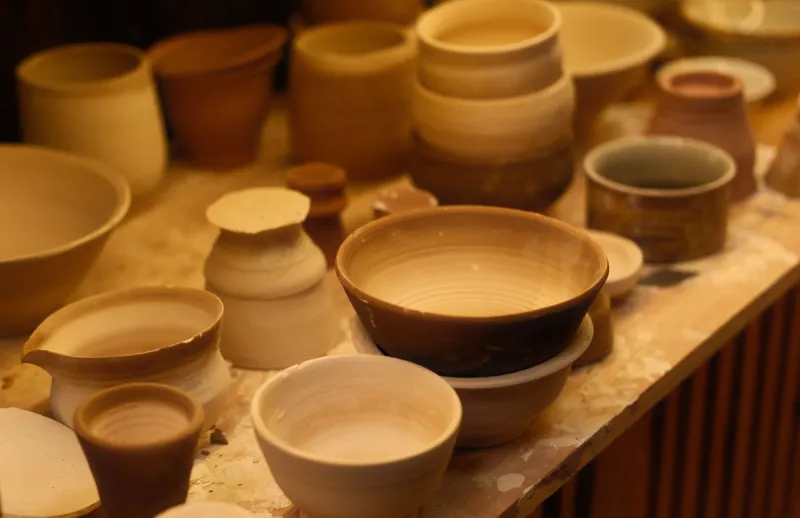
The same principle runs through yakimono (Japanese ceramics) and shodo (calligraphy). Both are disciplines where beginners are often surprised by how much there is to learn — and how long that learning takes.
A potter working in the Japanese tradition might spend years just understanding how a single type of clay behaves under different firing conditions. They're not trying to master every technique in every tradition. They're trying to know this clay, this kiln, this style — intimately, over time. The result isn't just skill. It's a kind of knowledge that lives in the body, that can't be Googled or fast-tracked.
Calligraphy students often describe something similar. The first brush strokes look terrible. The second hundred look slightly less terrible. Somewhere around the thousandth, something starts to click — not because you've cracked a code, but because your hand has finally started to remember what your eye already knows. That gap between seeing and doing, and the long, patient work of closing it, is exactly what yohohodo is about.
Why This Hits Different for Americans
Here's the honest tension: American culture is built around reinvention. We celebrate the pivot, the rebrand, the person who completely changed careers at 45 and never looked back. That's genuinely admirable in a lot of ways. Flexibility is a real skill. Curiosity is worth protecting.
But there's a cost to always moving on. When we quit something the moment it stops being new, we miss the part that comes after the beginner's high — the part where things actually get interesting. The intermediate stage of any skill is where most people bail, because it's hard and slow and unglamorous. But it's also where real understanding starts to form.
Yohohodo asks you to stay. Not forever — not if something genuinely isn't for you. But long enough to find out what's on the other side of frustration. Long enough to stop being a tourist in your own hobby.
How to Actually Try This
You don't need to move to Kyoto or apprentice under a tea master to bring a little yohohodo into your life. Here are some low-key ways to start:
Pick one thing and give it a real season. Not a week, not a month — commit to three to six months of practicing one skill without adding anything new. A single instrument. One style of cooking. A particular drawing technique. See what happens when you stay.
Let go of the progress tracker. Apps and streaks are great for building habits, but they can turn learning into a point-scoring exercise. Try practicing without measuring. Notice how that changes the experience.
Get comfortable with the plateau. In almost every skill, there are long stretches where you don't feel like you're improving. In the yohohodo mindset, that's not a sign to quit — it's a sign that something is quietly consolidating beneath the surface.
Find your version of a master. You don't need a formal teacher, but finding someone who's been doing what you're learning for twenty or thirty years — and spending time watching or talking to them — is genuinely illuminating. There's something about witnessing long-term commitment up close that recalibrates your own timeline.
The Quiet Reward
Here's what people who've practiced one thing for a long time often say: the craft starts to feel like company. It becomes something you return to, rather than something you're trying to conquer. The relationship changes from goal-oriented to genuinely ongoing.
That's not a small thing. In a culture that's constantly asking us what we've achieved lately, having something you're simply in the middle of — something with no finish line, no certification, no moment where you announce you've made it — is a kind of quiet freedom.
Yohohodo isn't about becoming the best. It's about becoming more fully yourself, through the patient, repeated practice of something you care about. And honestly? That sounds a lot more satisfying than another 30-day challenge.