The Bittersweet Lens: How Mono no Aware Is Quietly Changing the Way Americans Live, Decorate, and Love

Photo by Photo by Stephen Pontes on Unsplash on Unsplash
There's a particular kind of ache you feel watching a perfect sunset. You know it's almost over, and somehow that knowledge makes it more stunning, not less. The Japanese have a name for that feeling: mono no aware (物の哀れ). Loosely translated, it means "the pathos of things" — a gentle, bittersweet awareness that everything beautiful is temporary, and that impermanence itself is what makes beauty matter.
For a culture like ours that spends billions each year trying to preserve, upgrade, and future-proof everything, this idea can feel almost radical. But something is shifting. Slowly, then all at once, mono no aware is showing up in American design studios, lifestyle blogs, therapy conversations, and even the way people are choosing to arrange their living rooms. And honestly? It makes a lot of sense.
A 1,000-Year-Old Idea That Feels Surprisingly Timely
Mono no aware isn't new. The concept was articulated by the 18th-century Japanese scholar Motoori Norinaga, but its roots stretch back to the Heian period — think The Tale of Genji, misty mountains, and poetry written about falling autumn leaves. The idea is simple but layered: beauty is inseparable from transience. A cherry blossom is gorgeous partly because it falls. A handmade ceramic bowl is precious partly because it chips.
In Japan, this philosophy quietly shapes everything — from the way temples are left to weather naturally, to the practice of kintsugi (repairing broken pottery with gold), to the seasonal packaging on convenience store snacks. Impermanence isn't mourned. It's acknowledged, even celebrated.
In America, we've historically operated on the opposite principle. We laminate things. We seal them in resin. We build houses meant to last a hundred years and then panic when the paint fades. We treat aging as a problem to be solved, relationships as things to be locked down, and careers as ladders to climb indefinitely upward. Permanence equals success. Impermanence equals failure.
But cracks are forming in that worldview — and some of them are actually beautiful.
How It's Showing Up in American Design
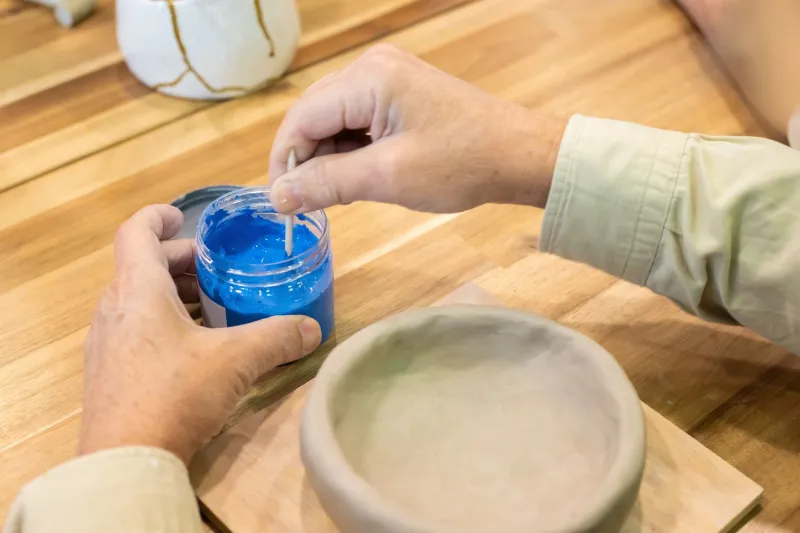
Walk through any design-forward neighborhood in Brooklyn, Portland, or Austin right now and you'll notice something: the aesthetic has gotten deliberately imperfect. Raw linen instead of polyester. Handthrown ceramics instead of mass-produced dinnerware. Wabi-sabi interiors (a related Japanese concept) that embrace worn wood, asymmetry, and the visible passage of time.
Mono no aware is operating just beneath the surface of all of it. Designers and homeowners are increasingly drawn to materials that change — leather that develops a patina, linen that softens with every wash, wood that shows its grain and its knots. The goal isn't a showroom. It's a home that tells the story of living in it.
This is a meaningful departure. For decades, American interior culture was about control — matching sets, uniform finishes, rooms that looked untouched. Now, the aspiration is something more honest: a space that acknowledges time has passed in it, and that this is actually a feature, not a flaw.
What It Does to Your Wardrobe
The slow fashion movement has been talking about quality over quantity for years, but mono no aware adds a different dimension to the conversation. It's not just about buying fewer things. It's about forming a different relationship with the things you own — one that includes their eventual end.
In Japan, there's a tradition of mending and altering clothes rather than replacing them, and of appreciating the way a garment ages. A well-worn denim jacket. A cashmere sweater with a small, carefully darned hole. These aren't signs of poverty or carelessness — they're evidence of a life being lived.
American fashion culture has started to catch on. Vintage and secondhand markets are booming. People are learning to darn socks, patch jeans, and care for natural fabrics. Part of this is economic; part of it is environmental. But a quieter part of it is philosophical — a growing discomfort with treating beautiful things as disposable.
The Harder Application: Relationships and Seasons of Life
Here's where mono no aware gets genuinely challenging for us. Applying it to a lamp or a linen shirt is one thing. Applying it to relationships, careers, or life chapters is another.
American culture tends to treat the end of anything meaningful as a failure. A job that doesn't last forever. A friendship that drifts. A chapter of life that closes. We pathologize endings, even natural ones, as things that shouldn't have happened.
Mono no aware offers a reframe. What if some relationships are beautiful because they belong to a particular season? What if a friendship that mattered deeply for three years — and then changed — was still a complete and valuable thing, not a broken one? What if leaving a career that no longer fits isn't giving up, but acknowledging that you've grown into a different shape?
This isn't about being passive or avoiding commitment. It's about holding the things you love with open hands — appreciating them fully, right now, without the anxious grip of trying to freeze them in place.
A Small Practice to Start
You don't need to redecorate your house or overhaul your wardrobe to start living with mono no aware. You just need to notice.
Next time something ends — a season, a phase of a relationship, a job, even just a really good meal — pause before moving on. Let yourself feel the bittersweetness of it. Not as a wound, but as a signal that something mattered. That ache? That's the feeling the Japanese have been naming and honoring for a thousand years.
And once you start seeing it, you'll find it everywhere: in the way afternoon light changes in October, in the last episode of a show you loved, in the quiet moment when you realize your kid doesn't need you to hold their hand crossing the street anymore.
Mono no aware doesn't ask you to be sad about these things. It asks you to be present for them — to let their temporary nature be part of what makes them shine.
That, it turns out, is a pretty good way to live.